Elementary School Case Study:
Eliminating "I can't"!
4th Grade Elementary - RuralA rash of "I can't do it" pervaded the classroom and stifled the learning environment in this fourth grade class, seriously hurting the learning experience for many students.
Living Consciously provided students an opportunity to look at the reasons why people say they can't do things. The students realized that often times, it was to cover up other feelings such as "I'm afraid to try because I might fail".... "I need extra help"..."I'm afraid of what my friends will say if I ask for help"... "I'll be embarrassed"...
The class decided that "I can't" was no longer acceptable and made a pact not to use the excuse. This discovery and discussion process shared by all, led students to open up and to support one another. No one was afraid to ask for more help. When a person was stuck or having trouble, classmates began to help each other. Shame and negative peer pressure were replaced with respect, cooperation and encouragement. Learning became the mutual goal for all. The students began to approach learning without anxiety.
They learned better than they did before Living Consciously.
Elementary School Case Study:
Short Attention Span - High Disciplinary Need
Second Grade - Urban
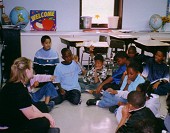 This elementary school in an urban setting decided to proceed with a pilot program for one of their second grade classes, during which two teachers and a counselor were trained in Living Consciously. Twenty five children experienced the program. This elementary school in an urban setting decided to proceed with a pilot program for one of their second grade classes, during which two teachers and a counselor were trained in Living Consciously. Twenty five children experienced the program.
Prior to Living Consciously, the classroom was in a worsening condition with constant, increasing disciplinary action required through the day; constant "acting-out" in children; and tremendous issues with short attention spans and oppositional behavior to learning.
The teacher found it easy to integrate Living Consciously into her class work in the morning. By doing so, she noticed immediately that the Living Consciously principles and lessons provided a vehicle through which the children could talk and work out their feelings and difficult situations facing them.
The children responded immediately to Living Consciously principles which gave them tools they could understand and use. There was a immediate and permanent change in the children's' attitude toward learning and their behavior in class. The teachers noticed a sharp increase in their ability to hold their attention on what was being taught and a sharp decline in disciplinary need. More time became available for stress-free learning and constructive activities.
The counselor reported that students began using the principles of Living Consciously throughout the school day, even when there was no authority figure to reinforce their choices. As their perception was changed, so did their behavior.
Following Living Consciously, the principal, two students and their teacher, made a presentation to the District Advisory Board for Education to tell them about Living Consciously and to request that it be used in all the grades and schools. Despite budget cuts in the area, the program has since been expanded into another elementary school and a middle school in that district, with plans for more!
The Living Consciously statistical reports have helped educators see and quantify the positive efforts the children are making. They have also defined and quantified the obstacles that are impacting learning at the school - and throughout the district. The precise feedback provided by the tracking reports has equipped them with the information needed to address the obstacles directly.
Through Living Consciously, these children are being given precisely what each one needs to realize their unique and full potential.
|