LIVING CONSCIOUSLY EDUCATION
MIDDLE or JUNIOR HIGH SCHOOL
"Living Consciously...will teach them...the life skills
that the real world tends to teach too late,
and often at much higher cost."
Living Consciously helps protect our young people from anything that is unconstructive around them in a balanced, constructive way.
 Middle school students, when exposed to Living Consciously principles, immediately begin to make new choices, better choices for their well-being. The result is a dramatically different and more positive future in all areas of their life. Middle school students, when exposed to Living Consciously principles, immediately begin to make new choices, better choices for their well-being. The result is a dramatically different and more positive future in all areas of their life.
A child who has entered middle school has begun to shift focus from family to peers. Hormonal changes are setting in. Middle school is a time of great stress for the child and everyone who is in his or her world. It is a crucial time as children begin to think about the world and what they value. They begin to make decisions about how to act, rather than just re-acting. They are becoming less flexible and their behaviors begin to be more permanent.
Because this age group does not have discernment abilities fully developed, they are like "sponges", soaking up examples from everything and anything upon which they focus their attention or energy. If information is not provided about how to live life constructively, they will be heavily influenced by the barrage of messages and images provided through role models on television, sports figures and entertainers, movies, videos, music and the internet. This can reach the point where teachers, parents and other traditional, less "extreme" daily influences will have a very difficult time modeling practical, constructive behaviors and ideas about Life.
The Ideal Use of Living Consciously for Middle or Junior High
For middle school, the ideal presentation of Living Consciously is a mandatory stand-alone course, integrated into the school curriculum, introduced by a special seminar. Follow-up activities are imperative. A stand-alone seminar can also bring results, but not at the level that a full commitment can bring to this crucial age group. Students in middle or junior high school need structure and consistency to anchor desired choices and behaviors.
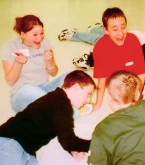 The curriculum can be presented by regular or special teachers. The program can be integrated into social studies, health or career development classes as well. Counselors can learn Living Consciously and present it in individual class settings, or with "pull-out" groups of students. The curriculum can be presented by regular or special teachers. The program can be integrated into social studies, health or career development classes as well. Counselors can learn Living Consciously and present it in individual class settings, or with "pull-out" groups of students.
To secure the new behaviors that Living Consciously teaches, continuous efforts beyond the curriculum are important to make the Living Consciously concepts part of the every day world that these youth are now creating for themselves. They need to apply the principles or even better, to teach them to someone else.
A Living Consciously club, community service projects, presentations to other schools or groups, a kid-parent club, buddy-system, mentoring, creating social opportunities with kids who have learned the Living Consciously principles are just some ways to use and integrate these concepts in a real world demonstration, making it the world of choice for the middle school student.
- Middle School Case Studies
- Severe At-Risk -- No Child is Lost
Middle & High School Students Talk about Living Consciously
"Everything makes more sense since Living Consciously. I am examining myself to see how I can improve and new ways of handling things. It was a boost onto the "track." LC has become my favorite discussion with my friends."
"I learned that the only limits I have are those I create myself."
"I've made new choices. I get my homework in on time, try harder and study more. I had a 1.7 GPA. Now I've got a 3.2. It's a lot more fun."
"We learned to focus on the good. We learned that we are making choices everyday and about the consequences of those choices."
"I don't do drugs anymore and I won't be around others that do."
"I found that when I give respect, courtesy and honesty, it has benefit to me."
"I decided to be nicer. I wasn't treating other people very well. They were teasing me a lot. I decided that if I stopped, they would stop. I did and they did."
"I learned that it is my choices that matter and how to make smarter choices looking at all parts."
|